The nucleus houses the cell's genetic material (DNA), essential for cell function and reproduction.
Cytoplasm serves as the medium for chemical reactions, facilitating metabolic processes.
Ribosomes are the sites of protein synthesis, translating genetic information into proteins.
Mitochondria are known as the powerhouse of the cell, where aerobic respiration occurs to produce ATP.
The cell membrane regulates the entry and exit of substances, maintaining homeostasis.
Plant cells also contain a cell wall for structure, chloroplasts for photosynthesis, and a large vacuole for storage.
Respiration Processes
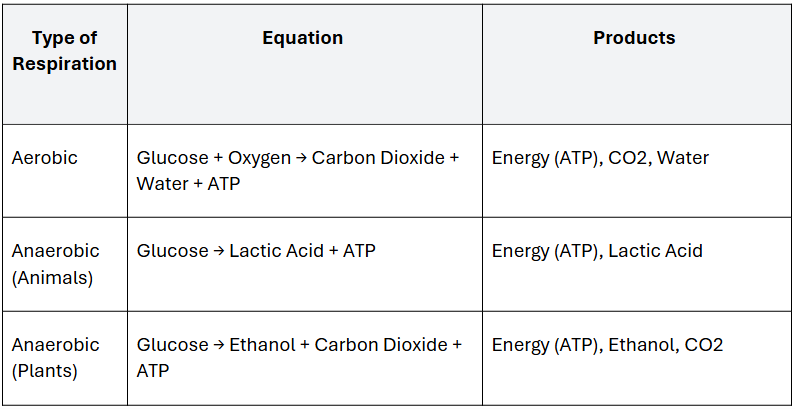
Respiration is an exothermic reaction that releases energy in the form of ATP, occurring continuously in all living cells.
Aerobic respiration requires oxygen, with the equation: Glucose + Oxygen → Carbon Dioxide + Water + ATP.
Anaerobic respiration occurs in low oxygen conditions, producing lactic acid in animals and ethanol plus carbon dioxide in plants and fungi.
The hydrogencarbonate indicator test detects respiration by changing color based on CO2 levels: red (neutral), yellow (high CO2), purple (low CO2).
Carbon dioxide is acidic and forms a weak acid in solution, influencing pH levels in biological systems.
Understanding respiration is crucial for studying energy production and metabolic pathways in cells.
Summary of Respiration Equations
Digestive System and Digestion
Overview of the digestive process
The digestive system breaks down food into smaller, absorbable molecules through mechanical and chemical processes.
Teeth cut and chew food, while saliva from salivary glands contains amylase to begin starch digestion.
The oesophagus transports food to the stomach via peristalsis, a series of wave-like muscle contractions.
The stomach mixes food with hydrochloric acid and enzymes, further breaking it down into a semi-liquid form.
The small intestine is where most digestion and absorption occur, aided by enzymes and a large surface area from villi and microvilli.
The large intestine absorbs water and minerals, forming waste for excretion.
Role of Digestive Enzymes
Digestive enzymes are biological catalysts that facilitate the breakdown of food molecules into smaller units.
Amylase converts starch into sugars, initiating carbohydrate digestion in the mouth.
Protease breaks down proteins into amino acids, essential for growth and repair.
Lipase is responsible for breaking down lipids into glycerol and fatty acids, important for energy storage.
The efficiency of digestion is enhanced by the presence of villi and microvilli in the small intestine, increasing surface area for absorption.
Conditions like Celiac disease can damage villi, reducing nutrient absorption and leading to deficiencies.
Nutrient Absorption and Importance
Villi in the small intestine are one cell thick, allowing for efficient nutrient absorption into the bloodstream.
Microvilli further increase the surface area, facilitating quicker absorption through diffusion.
A balanced diet is crucial for maintaining health, as deficiencies can lead to various health issues.
The digestive system's efficiency is vital for overall health, impacting energy levels and bodily functions.
Understanding the digestive process helps in recognizing the importance of nutrition and dietary choices.
Disorders related to digestion can significantly affect nutrient absorption and overall health.
Nutritional Components and Their Functions
Types of Nutrients:
Water is essential for hydration and maintaining bodily fluids, especially during sweating.
Fibers, though indigestible, are crucial for digestive health, preventing constipation and promoting regularity.
Micronutrients (vitamins and minerals) are needed in small amounts for various biochemical processes.
Macronutrients (carbohydrates, proteins, fats) provide energy and are necessary for growth and repair.
Carbohydrates are the primary energy source, primarily derived from starches broken down into glucose.
Proteins are vital for growth and repair, requiring breakdown into amino acids for absorption.
Importance of Macronutrients:
Carbohydrates are the most significant energy source, with starch being the primary form consumed.
Proteins serve as building blocks for tissues, requiring digestion into amino acids for utilization by the body.
Fats provide energy and insulation, with two types: saturated (solid at room temperature) and unsaturated (liquid).
Excessive saturated fat intake can lead to health issues, including heart disease.
A balanced intake of macronutrients is essential for maintaining health and preventing chronic diseases.
Understanding the role of each macronutrient helps in making informed dietary choices.
Food Testing Methods
Tests for Nutrients
The starch test involves adding iodine solution; a blue-black color indicates the presence of starch.
Reducing sugars are tested using Benedict's solution, which changes color from blue to green, yellow, orange, or red upon heating in a 90°C hot water bath if sugars are present.
The protein test uses biuret solution, turning violet/purple in the presence of proteins.
Lipids are tested by adding ethanol; a cloudy white precipitate indicates lipid presence.
These tests are essential for identifying nutrient content in food samples, aiding in nutritional analysis.
Understanding these tests is crucial for laboratory work in biology and nutrition.
Nutritional-related Disorders
Common Diet-Related Diseases
Obesity can result from various factors, including mental health issues, physical inactivity, and genetics.
Symptoms of obesity include fatigue, joint pain, snoring, and trouble sleeping, impacting quality of life.
Prevention strategies include maintaining a balanced diet and regular exercise to manage weight.
Treatment options may involve lifestyle changes, medical interventions, or surgery in severe cases.
Understanding the causes and effects of obesity is vital for public health initiatives and personal health management.
Awareness of diet-related diseases can lead to better dietary choices and healthier lifestyles.
Nutrition and Malnutrition
Overview of Malnutrition
Malnutrition is primarily caused by insufficient food intake, poverty, and mental health issues affecting dietary choices.
Symptoms of malnutrition include vomiting, diarrhea, and depression, indicating severe health impacts.
It can lead to various nutritional deficiencies, affecting overall health and development.
Specific Nutritional Deficiencies
Scurvy: Caused by vitamin C deficiency, leading to symptoms like weakness in bones and gums, fatigue, and muscle weakness.
Rickets: Resulting from vitamin D deficiency, symptoms include bending of leg bones, widening of knees, and bone pain.
Kwashiorkor: Caused by protein deficiency, characterized by stunted growth, swollen abdomen, and skin issues.
Prevention and Treatment Methods
Prevention methods for malnutrition include maintaining a balanced diet rich in essential nutrients and vitamins.
Treatment options involve improving nutrition through supplementation and lifestyle changes, such as regular exercise and a healthy diet.
Specific treatments for conditions like scurvy and rickets include dietary adjustments and exposure to sunlight.
Respiratory System and Gas Exchange
Anatomy of the Respiratory System
The respiratory system begins at the larynx, followed by the trachea, which is supported by flexible cartilage rings.
The trachea branches into two bronchi, leading to the lungs, where gas exchange occurs in the alveoli air sacs.
Bronchioles further divide within the lungs, facilitating air distribution.
Mechanism of Breathing
Inhalation involves contraction of intercostal muscles and the diaphragm, increasing lung volume and decreasing air pressure.
Exhalation occurs when these muscles relax, decreasing lung volume and increasing air pressure, forcing air out.
The pressure differential between the outside atmosphere and the lungs drives the flow of air during breathing.
Gas exchange is the process where oxygen from the air moves into the blood and carbon dioxide moves out of the blood into the air in the lungs. This occurs in the alveoli—tiny air sacs in the lungs—where gases pass through thin walls by diffusion due to concentration differences.
Impact of Smoking on the Respiratory System
Smoking introduces carcinogens, including tar and nicotine, leading to various respiratory diseases.
Conditions such as bronchitis and emphysema result from smoking, causing inflammation and reduced lung function.
Long-term smoking can lead to chronic conditions like smoker's cough and increased mucus production, complicating respiratory health.
The Heart
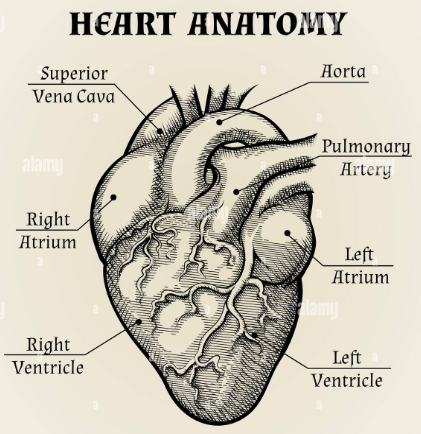
The vena cava is the vein that sends de-oxygenised blood to the Heart from the body into the right atrium, than into the right ventricle, where from there it goes to the lungs for oxygen through the pulmonary artery, and then to the left atrium throuhg the pulmonary vein, and then the left ventricle, and through the aorta, it goes to the whole body. The muscle of the left atrium is thicker because it has to pump more blood at a time, and it cannot meet the requirements without having a stronger muscle.
Effects of Smoking and Other Recreational Drugs
Health Risks Associated with Smoking
Smoking affects skin and bones, leading to premature aging and increased risk of osteoporosis in women.
It contributes to cardiovascular diseases, increasing the risk of strokes, heart attacks, and aneurysms.
Smoking also impacts fertility, causing erectile dysfunction and complications during pregnancy.
Overview of Recreational Drugs
Recreational drugs alter body chemistry; examples include cannabis, caffeine, heroin, cocaine, and alcohol.
Cannabis can cause hallucinations and long-term lung cancer risk; caffeine can lead to heart muscle damage.
Heroin and cocaine are highly addictive, with severe long-term effects including coma and death.
Long-term Effects of Substance Use
Long-term use of substances like alcohol can lead to liver problems, while smoking can cause chronic lung issues.
The addictive nature of drugs like heroin and cocaine poses significant health risks, including potential fatal outcomes.
Understanding the impact of these substances is crucial for prevention and health education.
Human Skeleton and Joints
There are 206 bones in the adult human body.
Muscles can only pull, not push; this is whhy they have to work together on a joint.
These are fibrous joints (immovable) -- no joint cavity, bones held together by connective tissue.
Cartilaginous joints (slightly movable) -- Bones held together by cartilage.
Synovial joints (freely movable) -- contains synovial fluid in a cavity.
Muscles work in antagonistic pairs. They work against each other on a joint.
Excersize investigation
Lower intensity activities make you have the lowest breathing rate and higher intensity activities make you have higher breathing rates. This is becuse your muscles contract more, and the muscle cells need energy to do that. To keep up with the energy demand, your cells need to respire more, so they need more oxygen, and to do that you need to breathe more. Same thing with the heart rate because your muscles work harder, therefore you need more energy, therefore you need more respiration, therefore you need more blood supply, and for that your heart would have to pump blood around more quicker and at a faster rate.