A day is the time for a planet to rotate once on its axis. For Earth, it is 24 hours – the length of time which lapses between the sun reaching its highest point in the sky 2 consecutive times. Different planets have different day lengths.
A year is the time it takes for the planet to complete an orbit of the sun. For earth, this is approximately 365.242 days. Because of this fractional extra day, every four yeaars, we have a leap year, when we add a day onto February. This day isn’t exactly six hours, so there is no leap year for every hundredth year.
Throughout the day the Sun will appear to move from East to West. As it does so, the Sun’s height about the horizon increases, then decreases. The maximum point of noon is defined as 12pm, but 12pm isn’t necessarily always noon.
The Seasons:
As well as the changes in temperature and weather, the position of the Sun of noon changes with the seasons. The day the sun is at it’s highest point is the summer solstice (June 21st), the day it is at its lowest point is called the winter solstice (December 21st). The days where the sun reaches its midpoint in the sky, when the hours of night and day are the same are called the equinox. The Earth’s axis is on a tilt of 23.5 ddegrees to its orbital path. As the sunlight is more concentrated in the summer in the northern hemisphere, the Earth’s surface will warm up faster. In the winter, the energy is more spread out so will not heat up as much.
Space:
The solar system:
Inner planets: Mercury, Venus, Earth, Mars. These are all terestrial planets. Gas giants: Jupiter, Saturn, Uranus, Neptune. THe solar system includes eight planets, dwarf planets, asteroids and comets. Asteroid: Large rocks in a stable orbit around the Sun. Comets: Icy rocky bodies in highly elliptical orbits.
Stars and Galaxies:
Galaxies are giant systems of stars, all orbiting around a central point.
Milkyway: Our galaxy is called the milky way. Our solar system is on the outer edge of the galaxy, we can see it in areas with very little light pollution, arching across the sky.
Exoplanets:
Every star in a galaxy potentially has its own ystem of pplanets, like our own. In 1995, the first exoplanet was detected in a star system other than aour own. Since then, we have discovered 5,100 planets in 3,800 systems.
Mass and weight:
Mass:
This is the measure of how difficult it is to accelerate an object (changes its speed and direction). If an object contains matter, it is made of atoms. We measure mass using a mass balance. The standard unit we use in physics is the kilogram (kg).
Weight:
This is the force due to gravity acting upon an objejct with mass. Like all forces, weight is measured in Newtons (N). The forces exerted can be measured using a newton meter. The formula for the weight is Weight = Mass x gravitational field strength.
A satellite needs to be moving at a certain spped to stay in it’s orbit. If it’s too slow, then it will fall to Earth but if it’s too fast, it will spin off into outer space. The force off gravity is greatest close to a planet, so satellites that are in low orbits need to move much faster than satellites in higher orbits. Closer satellites also complete their orbits quicker because they have a much shorter distance to travel than for satellites orbiting further out.
A satellite in a low orbit will only take a few hours to orbit the Earth, If it’s orbit is tilted relative to the Equator, it will move over different parts of the Earth.
If a satellite is in an orbit that takes it over the North adn SSouth poles, it will eventually cover all parts of the Eaarth as the Earth spins beneath it. This kind of orbit is called a polar orbit.
Some satellites are far enough from the Earth to take exactly 24 hours to complete one orbit. This means that these satellites will stay over the same place on the Earth all the time. This kind of orbit is called a geostationary orbit. Satellites in geostationary orbits are usually over the equator.
Electricity — Static charge:
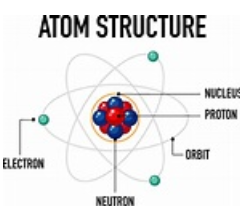
Structure of an atom:
When there are the same number of protons and electrons in an atom, their charges cancel each other out and the atom has no charge. Objects can become charged when rubbed with an insulating material. Only electrons are allowed ot be transferred from one atom to another. A atom that has been charged is no longer an atom but is an ion. If an ion has more protons than electrons, it has a positive charge. If it has less protons than electrons, then it has a negative charge. Like charges repel each other, while opposite charges attract.
Circuit Components:
Switches are used as an easy way to make or break a circuit, turning it on or off.
A LDR changes its resistance according to how much light is shone onto it.
Cells give power to the circuit and store chemical energy.
Batteries are two or more cells in a circuit together.
An ammeter is used to measure current, and is always placed in series.
A diode only allows the current to flow one way.
A variable resistor enables you to change its resistance. They often have a dial to allow the resistance to be changed.
An LED stands for a light emitting diode. This is a special kind of diode that releases light.
A fuse is a safety component. If a current becomes too high, it melts and breaks the circuit preventing a fire or damage.
A voltmeter is used to measure potential difference, and is always placed in parallel.
A thermistor changes its resistance according to its temperature.
A resistor provides a constant resistance to the circuit. This is important if you want to have a specific current or potential difference running through other components in the circuit.
Circuits:
Charge or electrons — The particles moving through a circuit that will transfer the energy from cell to components.
Current – A mesure of how much charge is moving past a point in a certain amount of time. Usually measured in amperes, A.
Voltage – A measure of how much energy each charge is gaining or losing as it passes through a component. Usually measured in volts, V.
Series — The components are connectedd along the same stretch of wire. Parallel: The components are connecteed to different branches.
Measuring voltage and current:
Voltimeters are used to measure voltage (potential difference). Measured in volts. Voltimeters are connected in parallel.
Resistance:
Resistance opposes the flow of charge (the currents).
The greater the resistance of a component, the more energy a charge loses flowing through it. To calculate the resistance, you use the formula: V (voltage) = I (current) x R (resistance). This can also be written in the form V=IR.
Series circuit rules:
The current is the saame at all points in a series circuit. The voltage gained from a cell/battery is shared across the components in series.
Parallel circuit rules:
The current is shared through each path. Adding an extra branch increases the total current. The voltage across each path is equal.
Magnetism:
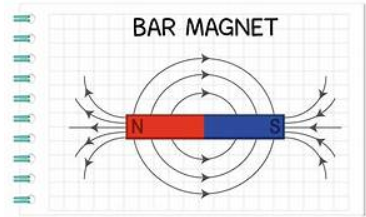
Magnets have a North and South pole. The poles are the strongest parts of a magnet. Like poles repel, unlike poles attract. A magnetic material is attracted to either pole of a magnet. The magnetic materials are iron, nickel and cobalt. Steel is also magnetic because it is between 98 and 99% iron.
Test for a magnet:
Repulsion is the test of a magnet. A magnetic material will attract to either end of a magnet. A magnet will only attract to the opposite end of the magnet.
Maagnetism is a property of the atoms in magnetic materials. Little groups of atoms act like tiny magnets. Each little group of atoms is called a domain. A normal piece of iron does not seem to be magnetic because all the domains are magnetised in different directions. They cancel each other out. When a piece fo iron is magnetised all the domains line up. They do not cancel each other out any more.
Making magnets:
You can magnetise a piece of iron by stroking it. You always have to stroke in the same direction so that ll the domains line up. You cna also magnetise a piece of iron by leaving it next to another magnet for a while. Eventually, the domains move around so they are lined up.
Removing magnetism:
You can’t stop a magnet by cutting it up. If you break a magnet in two, the two halves would both be magnets, eaach with a north pole and a south pole. This is because all the domains move around so they are lined up. To destroy a magnet you have to get the domains to point in different directions, there are 2 ways of doing this:
If you hammer a magnet, the vibrations let some of the atoms move around a little inside the metal. The domains can move around, ending up pointing in different directions.
You can also remove magnetism by heating the magnet. This makes the atoms vibrate causing the domains to move around.
Can magnetism be stopped:
In this example, apparatus is set up where there is a stand, a clamp attatched to the stand holding a bar magnet, a paperclip attatched to one side of a thin nylon thread, and the other side is held onto a surfae with a piece of tape. Only magnetic materials block the magnetic force, nothing else can.
Magnetic fields:
A magnetic field is the region around a magnet where a force acts on another magnet or on a magnetic material:
For more revision resources for Physics, head to Physics and Maths tutor. ↓